


It is easy to assume that your competitors have workforce strategy all figured out, but in reality, almost everyone is learning as they go. Some pick up bruises, others build momentum, but all chart their own course. I see leaders with vision in every industry, but they also have a mountain of daily firefighting and to-do lists. That is the human side of workforce planning. We are all pulled between what we want to accomplish and what the day demands.
Are businesses creating effective workforce strategies?
The findings of our 2026 poll of more than 100 labor decision-makers at the CWS Europe Summit highlight the widespread uncertainty that businesses today have regarding their strategic path. One set of questions in our survey asked respondents to evaluate their workforce planning skills in addition to workforce strategy and total talent integration.
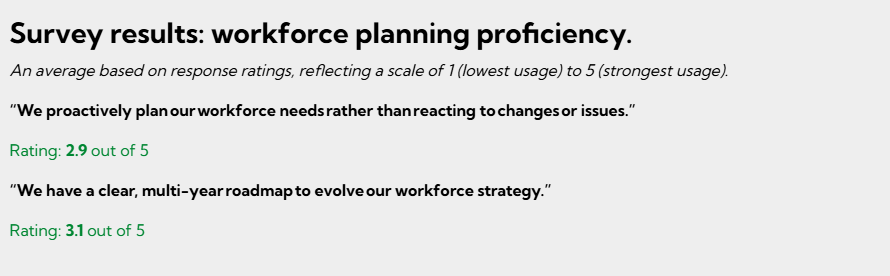
These findings show a lackluster level of trust in workforce planning, and the study also revealed that 40% of participants function in a reactive manner. Everyone agreed that preparation, adaptability, and foresight were essential. In certain instances, they may have recorded the precise enhancements that are required, yet comparatively nothing is done. What is causing this inertia? Too often, initiatives get hijacked by immediate fixes: an RFP, a tech rollout, or a sudden financial emergency. Long-term confidence is jeopardized by short-term needs.
A methodical approach to development is one of the keys to improvement.
How may the shortcomings preventing an effective workforce planning function be filled? Basic, proactive planning is the first step toward the future. Predictive data-driven planning and recorded roadmaps result from this. As you develop the flexibility to modify your tactics without breaking them, the process grows. Technological advancements, process innovations, and real-world achievements that foster support all have an impact. The following steps can help you move forward.
Assess the current state and the issues.
Too often, organisations begin searching for a workforce solution before clearly defining the problem they’re trying to solve.
A workforce management programme should directly support broader business objectives, whether accelerating innovation, improving operational efficiency, supporting geographic expansion, or building critical skills capabilities.
Before evaluating providers, technologies, or operating models, focus on understanding what already exists. This means assessing:
- Current workforce strategies and initiatives
- Existing governance structures
- Key stakeholders across HR, procurement, talent acquisition, finance, and operations
- Long-term business goals and growth plans
- Strategic drivers influencing workforce decisions
Developing a clear workforce strategy that addresses documented business issues and priorities should be the first step. Without this foundation, even the most advanced technologies or outsourced programmes risk becoming disconnected from business needs.
Survey the broader business environment.
Many workforce strategies fail because they’re developed in isolation. Address this risk by adding a distinct step in development: assessing context. The aim is to understand what else is happening across the business that may influence workforce initiatives.
Leaders should evaluate existing programmes and business priorities such as:
- Enterprise technology transformations
- Mergers and acquisitions
- Skills-based hiring initiatives
- Digital transformation efforts
- Organisational redesign programmes
- Cost optimisation initiatives
These efforts have significant workforce implications. For example, investing heavily in skills-based hiring may require tools that provide greater visibility into both internal and external talent supply and capabilities. Similarly, a large-scale technology transformation could create opportunities to integrate workforce management solutions into broader enterprise systems.
Develop a roadmap.
Most improvement and transformation initiatives require multiple stages to diagnose current-state challenges, design future-state solutions, implement technology, establish governance frameworks, and continuously refine processes. An effective, strategic roadmap is geared toward connecting actions to outcomes that empower next steps. These connections are flexible because they build on key fundamentals, including:
- Governance: Who owns workforce decisions? How will stakeholders collaborate? What decision-making processes are required?
- Solutions: Which workforce programmes and operating models will best support strategic goals?
- Technology: What systems, data, and integrations are needed to enable visibility, reporting, and workforce intelligence?
Maintaining direction: strategy as a dialog.
Do not let perfection stand in the way of advancement. A successful workforce strategy is a journey, and the right partner—internal or external—can play a crucial role in directing that course, allowing you to take a break, zoom out, and redraw the map. Invest in the discipline of honest introspection, frequent check-ins, and candid dialog. Pace is not as important as progress, and the best tool for keeping your plans on course may be a solid collaborator.